
Governance Workshops
From instinctive reactions to disciplined governance
Boards don’t usually struggle because they lack commitment or expertise.
But they often misfire when pressure, ambiguity, and good intentions collide.
This training is designed to help boards see more clearly, hold their role with discipline, and choose governance responses with confidence – especially when the work is complex and contested.
What makes this training different
Most board training starts with what boards should do – but this is already the work of the Board Deck.
Instead, this programme starts earlier – with how boards see the work.
Rather than prescribing best practice, it builds a shared orientation so boards can:
– recognise common governance misfires
– locate where work genuinely sits
– apply the right kind of effort
– and anticipate the consequences of their decisions.
The focus is not compliance or competence – but clarity under pressure.
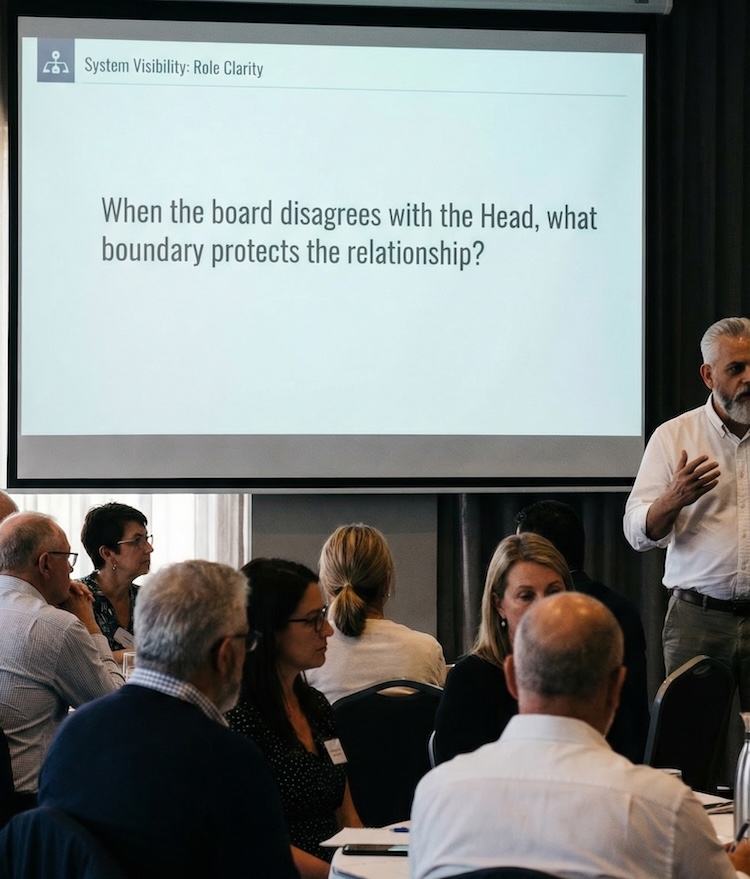
What boards will work on
1. Why boards misfire
Through short, realistic scenarios, boards surface the subtle pulls that lead to:
– action bias
– role drift
– premature certainty
– blurred accountability
The emphasis is on patterns – not people.
2. Orientation before action
Boards learn a disciplined way to pause and orient before responding.
– identifying the work and
– holding their lane
This creates a shared language for staying in role when stakes are high.
3. Governance modes – applied, not abstract.
Boards practise choosing how to govern – without collapsing back into management or advice.
4. Trade-offs and consequences
Using structured scenarios, boards explore how different governance stances shape system behaviour over time.
The focus is not on finding “the best answer”, but on understanding:
– second- and third-order effects
– unavoidable trade-offs
– why some tensions cannot be resolved – only governed
How the training works
– Scenario-based and highly interactive
– Designed for discussion, not presentation
– No prior preparation required
Adaptable to:
– one full day
– a twilight session plus a full day
– or two days for deeper work
The structure flexes; the discipline doesn’t.
What boards leave with
– A shared way of seeing governance challenges
– Greater confidence holding ambiguity and tension
– Clearer boundaries between governance and management
– A practical orientation that carries into board meetings – not just the training room
Good governance isn’t about having the right answers.
It’s about asking the right questions – in the right place – at the right time.