
What's Worth Learning
What’s Worth Learning makes an uncomfortable argument. The long-standing promise of education – that learning leads to work, work leads to identity, and identity leads to a meaningful life is beginning to fracture.
Not because educators have failed, but because the world has shifted faster than our institutions were designed to respond.
Many current responses – adding skills, refining assessment, integrating technology – have been necessary, but they no longer go far enough. They treat symptoms while leaving the deeper structure intact.
This book argues that what education must now cultivate, in young people and adults alike, is generative discernment (see below).
This is not a curriculum change. It is an architectural reorientation.
Download the PDF Whats Worth Learning v2 digital
Or watch the full-length video

Generative Discernment and the Learning Deck
Much of education focuses on what learners should know and how they should learn it. Far less attention is given to the deeper capacity learners need when answers are unclear, situations are complex, and outcomes are uncertain
We call this capacity generative discernment.
Generative discernment is the ability to:
- read patterns – not just recognise them, but interpret what they mean
- judge what matters – and hold that judgement under pressure
- commit when outcomes are uncertain – to persist toward something worth pursuing
- create new patterns – to author, not just adapt
These are not abstract ideals. They are practical capacities that shape how learners think, choose, and act in the real world.
What matters most is this: generative discernment is not taught directly.
It is developed through the conditions we design for learning.
That is where the Learning Deck comes in.
The Learning Deck: a framework that conditions discernment
The Learning Deck maps teaching and learning across two intersecting axes:
- Teaching approaches: Inform → Inquire → Inspire
- Learning impact: Enjoy → Engage → Empower
Together, these form a 3×3 framework that describes nine learner profiles – from Relationship Builder to Visionary Leader. The framework is deliberately non-linear. It is not a progression model or a checklist. Instead, it describes how different forms of learning experience cultivate different capacities in learners.
When viewed through the lens of generative discernment, something important becomes clear:
The Learning Deck already develops the capacities of discernment – by design.
Where the alignment shows up
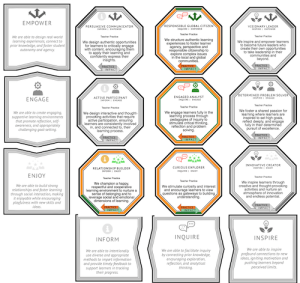
Reading patterns
is cultivated through relational learning, inquiry, and analytical engagement. Learners learn to notice social dynamics, conceptual structures, and contextual signals – not just surface features.
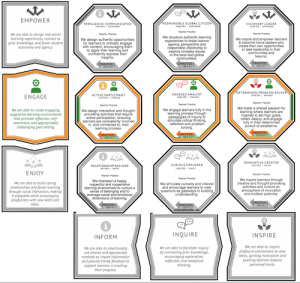
Judging what matters
is strengthened when learners must prioritise attention, evaluate evidence, and make choices about focus and effort, particularly when tasks are challenging or ambiguous.
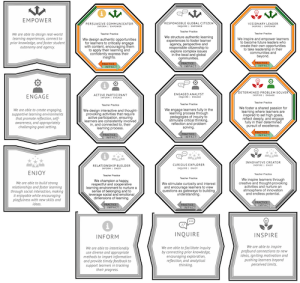
Committing under uncertainty
emerges when learners articulate ideas, persist through difficulty, and take responsibility for their learning without guarantees of success.
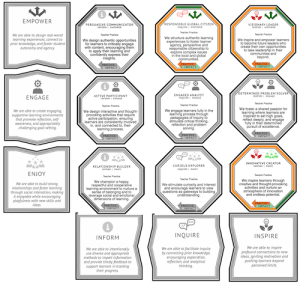
Creating new patterns
becomes possible when learners are empowered to apply learning in authentic contexts, generate new ideas, and initiate action that influences others.
None of these capacities sit on top of the Learning Deck as an “extra”.
They emerge through movement across the framework – as learners experience different combinations of teaching approach and learning impact.
Why this matters
The Learning Deck provides a shared language for teaching and learning.
Generative discernment clarifies why that language matters.
Together, they articulate a coherent view of education that prepares learners not just to perform well in known conditions, but to think wisely, act responsibly, and create meaning when the path ahead is unclear.
That is, ultimately, what is worth learning.