Induction Guide
Frame Deck
Six short sessions that walk through the FRAME framework — Focus, Reflect, Assess, Map, Exit — for preparing for difficult conversations. Pick a card to start.
Sessions 2–7 are available to registered purchasers — tap a locked card to enter the access password.
This session is locked
Sessions 2–7 are available to registered purchasers of the Frame Deck. Enter your access password to read this and the other locked sessions.
Don't have a password? Email nik@learning-deck.com.
Session 01 · Open
Start here — Introduction to Frame
What this deck helps you do — and how the cards fit together. 20–30 minutes.
Before you begin
Think of a conversation you need to have that you are not looking forward to:
- something is misaligned
- something needs to change
- something feels difficult to say
This is where this deck is used.
What this deck helps you do
Most conversations fail before they begin. Not because of what is said — but because of how they are prepared. This deck helps you prepare how to enter the conversation.
What's in the deck
You'll notice four types of cards:
FRAME cards
Structure. Five letters that organise your preparation: Focus, Reflect, Assess, Map, Exit.
Phrase cards
Language. Ready-made openings, responses under pressure, and ways to maintain clarity without escalation.
Insight cards
Mindset. Common mistakes, mindset traps, and patterns that derail conversations.
Language traps
What to avoid. How conversations get derailed, how power gets lost, how others may shift the ground beneath you.
Inquire cards
Reflection. Questions that deepen your own thinking before — and after — the conversation.
1. The structure: F.R.A.M.E. ℹ︎
FRAME is a simple structure to help you think before you act:
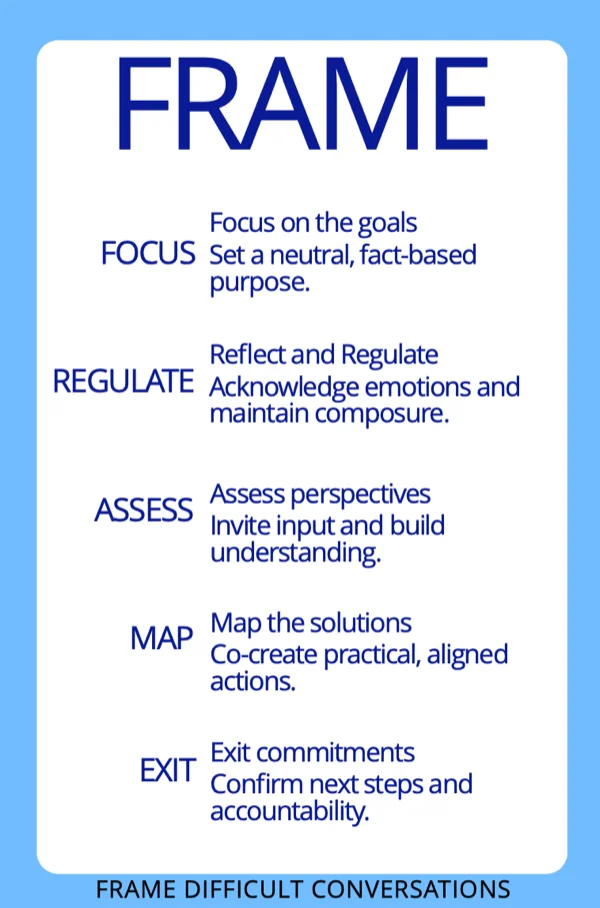
This is not a script. You do not follow all five steps every time. You use what you need.
2. Phrase cards ℹ︎
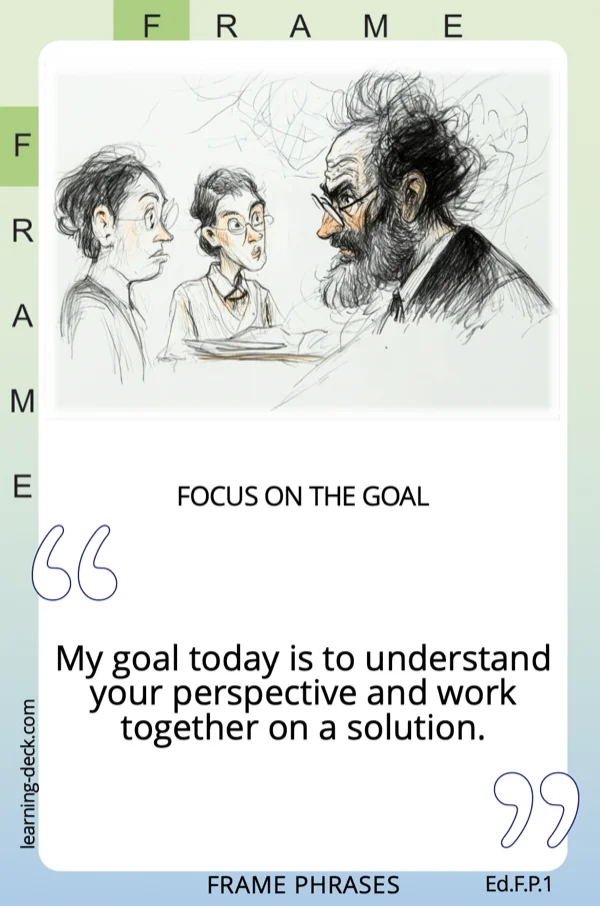
Phrase cards offer:
- ways to open conversations
- ways to respond under pressure
- ways to maintain clarity without escalation
They help you say difficult things without creating unnecessary defensiveness.
3. Insight cards ℹ︎
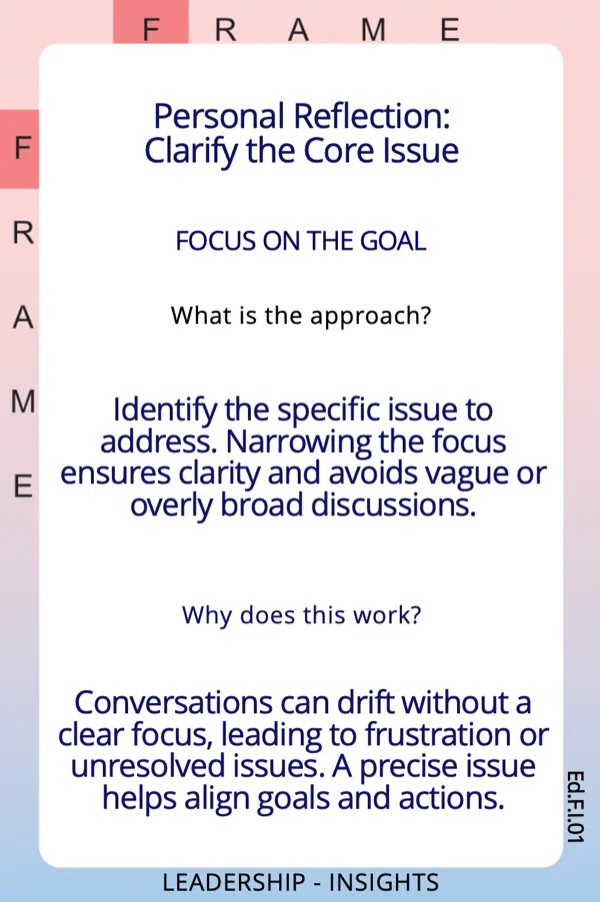
Insight cards highlight:
- common mistakes
- mindset traps
- patterns that derail conversations
They help you notice what often goes wrong before it goes wrong.
4. Language traps ℹ︎
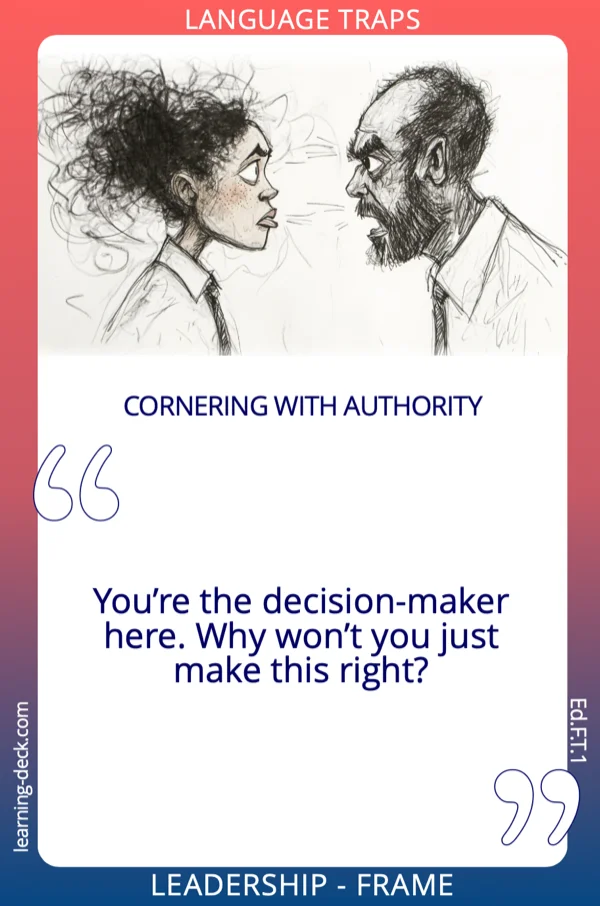
Language Traps show:
- how conversations get derailed
- how power gets lost
- how others may shift the conversation
They help you stay steady when conversations become difficult.
5. Inquire cards ℹ︎
Inquire cards offer:
- questions to deepen your own preparation
- prompts that surface assumptions you might be making about the situation
- reflection questions for after the conversation — what changed, what didn't, what would you do differently next time
They help you move from preparing what to say to understanding what's actually at stake.
How it fits together
- FRAME → structures your preparation
- Phrases → shape your language
- Insights → sharpen your thinking
- Traps → protect your position
- Inquire → deepen your own reflection
One line to hold
Conversations are shaped before they begin.
What this is — and what it isn't
This is not a collection of good thinking tools. The world has plenty of those. Adding more to the pile rarely changes how a difficult conversation actually goes.
This is about disciplined thinking — not more thinking.
The discipline is choosing fewer cards, used deliberately, in the moments that matter. The deck loses its power the moment it becomes a checklist. It earns its power when one well-placed move changes how a conversation lands.
Where this deck fits in the suite ℹ︎
This deck answersHow do I prepare for this conversation?
Across all eight: make the invisible visible → choose deliberately → act precisely → reflect and adapt.
Where to go from here
You've now seen what's in the deck — the FRAME structure, plus Phrase, Insight, Inquire, and Trap cards. That's enough to start with. The next session takes you into the first letter of FRAME — Focus on the Goal — with a real conversation in mind.
If you're leading a team
- Don't introduce this as a framework first — that turns it into a lecture
- Start with a real scenario. Ask how people would respond.
- Then introduce one FRAME card
- Then add phrases or traps as the conversation calls for them
Avoid: using all five stages at once · scripting conversations · over-preparing · treating the deck as a checklist or a set of techniques to apply.
Other decks help you understand situations. This deck helps you act within them. The next session takes you into the first letter of FRAME — Focus on the Goal — with a real upcoming conversation in mind.