Induction Guide
Praxis Deck
Five short sessions to turn the moments you already notice in lessons into deliberate teaching moves. Pick a card to start.
Sessions 2–6 are available to registered purchasers — tap a locked card to enter the access password.
This session is locked
Sessions 2–6 are available to registered purchasers of the Praxis Deck. Enter your access password to read this and the other locked sessions.
Don't have a password? Email nik@learning-deck.com.
Session 01 · Open
Start here — Orientation
What this deck is built on, and how Praxis turns insight into action. 20–30 minutes.
Before unpacking the strategies in detail, see the structure. Praxis is a system, not a library of techniques. It's designed to sit alongside the Learning Deck — where the Learning Deck helps you recognise what kind of learning is happening, Praxis helps you shape it.
Before you begin
Open the deck and sort the cards. You'll notice two main types:
Square & octagonal cards (blue & green)
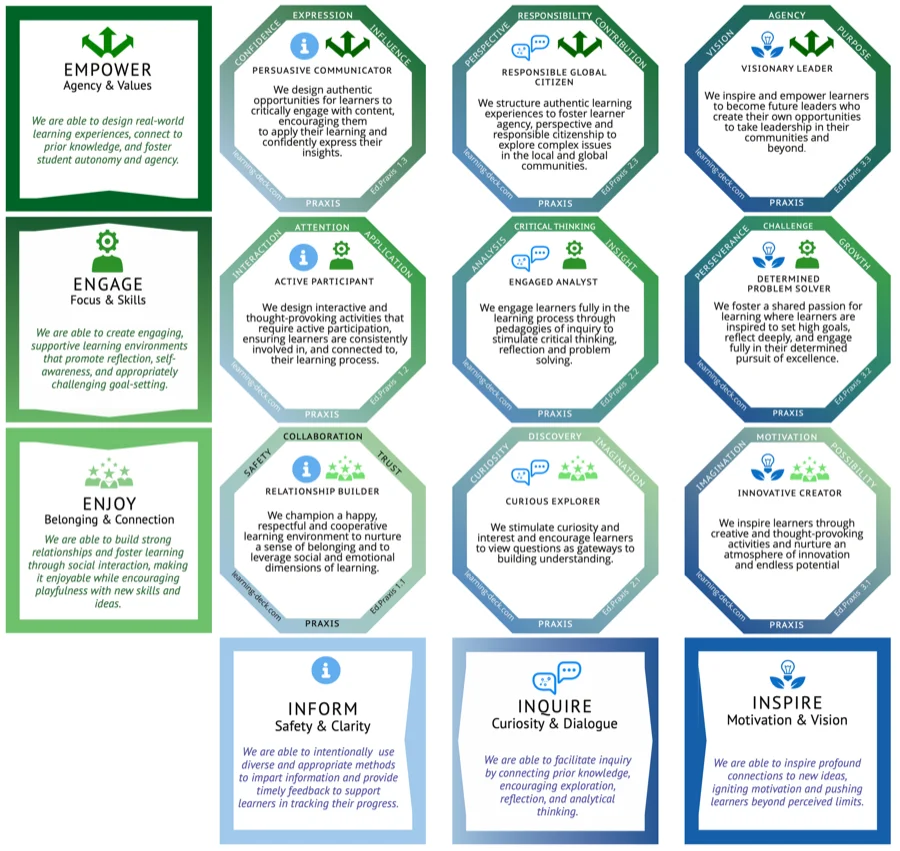
Principles & profiles. The same structure as the Learning Deck. Three teaching principles × three learning principles → Nine Map.
Coloured strategy cards (multiple sets)
Praxis cards. Concrete moves grouped by purpose — routines, starters, checking for understanding, feedback, language for learning, and more.
1. The foundation: Principles & Profiles ℹ︎
The blue and green cards mirror the Learning Deck's structure. Two axes:
- Teaching (what the teacher does): Inform · Inquire · Inspire
- Learning (what the student experiences): Enjoy · Engage · Empower
Together they form a 3 × 3 = nine learning experiences.
2. The structure: the Nine Map ℹ︎
The Nine Map sits behind the deck. Each intersection is a profile — a particular kind of learning experience.
3. The role of Praxis
The key shift
The Learning Deck helps you recognise what kind of learning is happening.
The Praxis Deck helps you decide what to do about it.
You're no longer just observing learning. You're shaping it.
4. The Praxis cards: shaping learning ℹ︎
The coloured strategy cards are grouped into practical areas — for example:
- Classroom routines
- Lesson starters
- Checking for understanding
- Instructional strategies
- Feedback and response
- Relationships and belonging
- Language for learning
They answer one question: "if I want more of this type of learning, what can I do differently?"
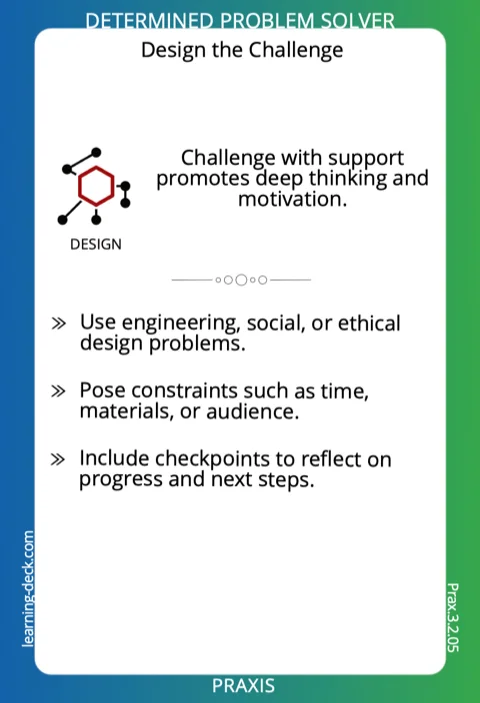
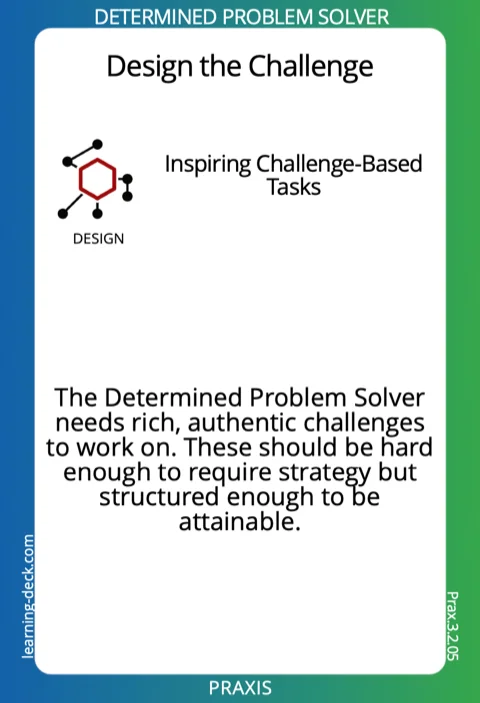
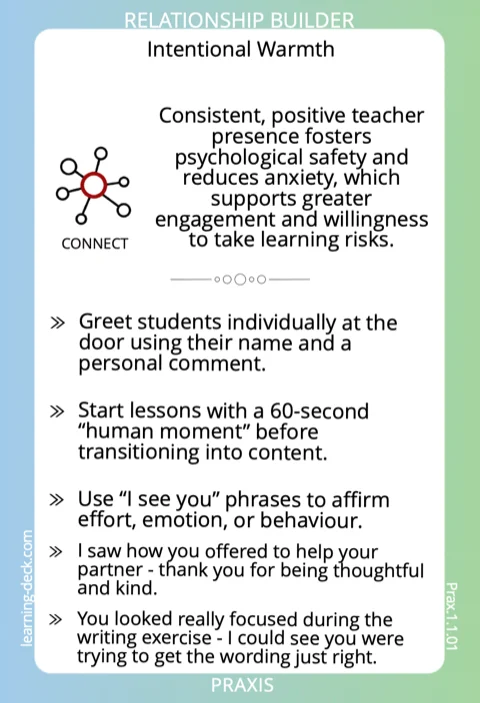
You don't need to use many at once. This isn't about applying lots of strategies — it's about choosing one move, at the right time.
How it fits together
- Principles & Profiles → define the type of learning
- Praxis cards → shape what happens next
Where this deck fits in the suite ℹ︎
This deck answersWhat can I do to improve that learning?
Across all eight: make the invisible visible → choose deliberately → act precisely → reflect and adapt.
Where to go from here
You've seen the structure — the principles & profiles that name kinds of learning, and the Praxis strategy cards that shape it. That's enough to start with. The next session takes you into your first real Praxis moment: a small shift, deliberately chosen, that changes what students do.
One line to hold
Praxis turns insight into action. Or — to put it another way — this is not about collecting strategies. It's about selecting the right move.
If you're leading a team
- Don't begin by introducing all the strategy cards — that's a sales pitch, not a learning experience
- Start with a shared lesson example (or a single Scenario card)
- Locate it on the map together
- Choose one Praxis card. Test one change. Reconvene.
Avoid: trying multiple strategies at once · over-planning · turning the deck into a checklist.
The same map appears across Learning, Leadership, and Governance — Praxis is the layer that connects insight to action. The next session takes you into your first real Praxis moment.