Perspective
The Hidden Operating System
Every teacher has seen it. A child who knew the answer. And said nothing.
The Child Who Knew
Every teacher has seen it.
A child who knew the answer.
And said nothing.
The teacher asks the question.
Three hands go up immediately.
A fourth hand begins to rise, pauses halfway, and slowly returns to the desk.
The child looks at the table.
Then at the teacher.
Then at the children whose hands are already high in the air.
By the time the calculation has finished, the moment has passed.
Someone else answers.
The lesson moves on.
Nothing dramatic happened.
No one was unkind.
No one noticed.
The Own Goal
There is another version of the same moment.
A ball rolls into the wrong net.
For a second, everything stops.
The child looks around.
Some children laugh.
Some do not.
The teacher on duty is too far away to know whether the laugh was kind.
By the following week, the match has disappeared from everyone else's memory.
For one child, something remains.
But the same moment produces different adaptations.
One child stops playing football.
Another becomes louder.
Another blames first.
Another turns the moment into a joke before anyone else can.
Another practises every afternoon until they are the best player in the class.
Adults may tell different stories.
"She's shy." "He's competitive." "She's resilient." "He doesn't like team games."
Perhaps.
Or perhaps the child is simply adapting.
The Date
In another classroom, two children open their books.
The teacher has already started the lesson.
One child writes the date and begins the first problem.
The other looks at yesterday's page.
Then at the board.
Then at the child beside them.
Is the date underlined?
Is there a title?
Should the margin be skipped?
Is pencil allowed?
Five minutes pass.
Both children are capable.
One has spent five minutes learning mathematics.
The other has spent five minutes learning classroom rules.
The Meeting After The Meeting
Years later, the same pause appears in a different room.
The meeting ends on time.
The Head thanks everyone for their contributions.
The minutes will record: discussion held, proposal supported, next steps agreed.
Chairs scrape backwards.
Laptops close.
People stand.
Then two middle leaders slow their walk towards the door.
"I wasn't sure about that staffing proposal." "Neither was I." "I didn't want to derail the meeting." "I thought it was just me."
A third person joins them in the corridor.
Five minutes later, in a space with no agenda and no minutes, the most thoughtful conversation of the afternoon begins.
The meeting looked aligned.
The thinking happened somewhere else.
The Board Question
The board paper is clear.
The recommendation is sensible.
The chair asks whether there are any questions.
A board member looks down at the report.
Something does not quite fit.
Not enough to object.
Not enough to sound certain.
Just enough to make the question worth asking.
She looks around the table.
The finance chair has already nodded.
The Head looks tired.
The meeting is running late.
The question remains in the margin of her printed paper.
After the meeting, she sends an email.
The Pattern
A hand lowers.
A child looks around after an own goal.
A student waits to see where the date goes.
A leader saves the question for the corridor.
A board member writes the question in the margin.
Different rooms.
Different ages.
Different responsibilities.
The movement is familiar.
Look around.
Calculate risk.
Protect belonging.
Decide whether participation is worth the cost.
Most of this happens too quickly to notice.
Repeated often enough, it becomes efficient.
Efficient enough, it begins to look like personality.
The Hidden Operating System
There is the lesson.
And there is the system running underneath the lesson.
There is the meeting.
And there is the system running underneath the meeting.
There is the policy, the agenda, the curriculum, the strategy.
And there is the quieter system of permissions, penalties, routines, memories and expectations that tells people what participation costs.
That quieter system is what schools often call culture.
But culture is not atmosphere.
Culture is remembered adaptation.
It is the collection of adaptive routines that enough people have repeated often enough that they now feel normal.
It is the operating system everything else runs inside.
Policies, initiatives, curricula and meeting structures are applications.
Applications can only run within the constraints of the operating system.
Attention Goes Somewhere
Attention always goes somewhere.
Sometimes it goes to the mathematics.
Sometimes it goes to the date.
Sometimes it goes to the question.
Sometimes it goes to the room.
Sometimes it goes to the chair, the colleague, the silence, the previous meeting, the thing that happened last time.
This is not lack of intelligence.
It is not always lack of motivation.
It is the operating system doing what experience taught it to do.
The work may be visible.
The background processes are not.
Every environment, intentionally or not, allocates attention.
The question is not whether people are paying attention.
It is what the environment is making them pay attention to.
One Movement. Different Lenses.
Learning, leadership and governance often look like different challenges. They are better understood as different expressions of the same underlying movement.
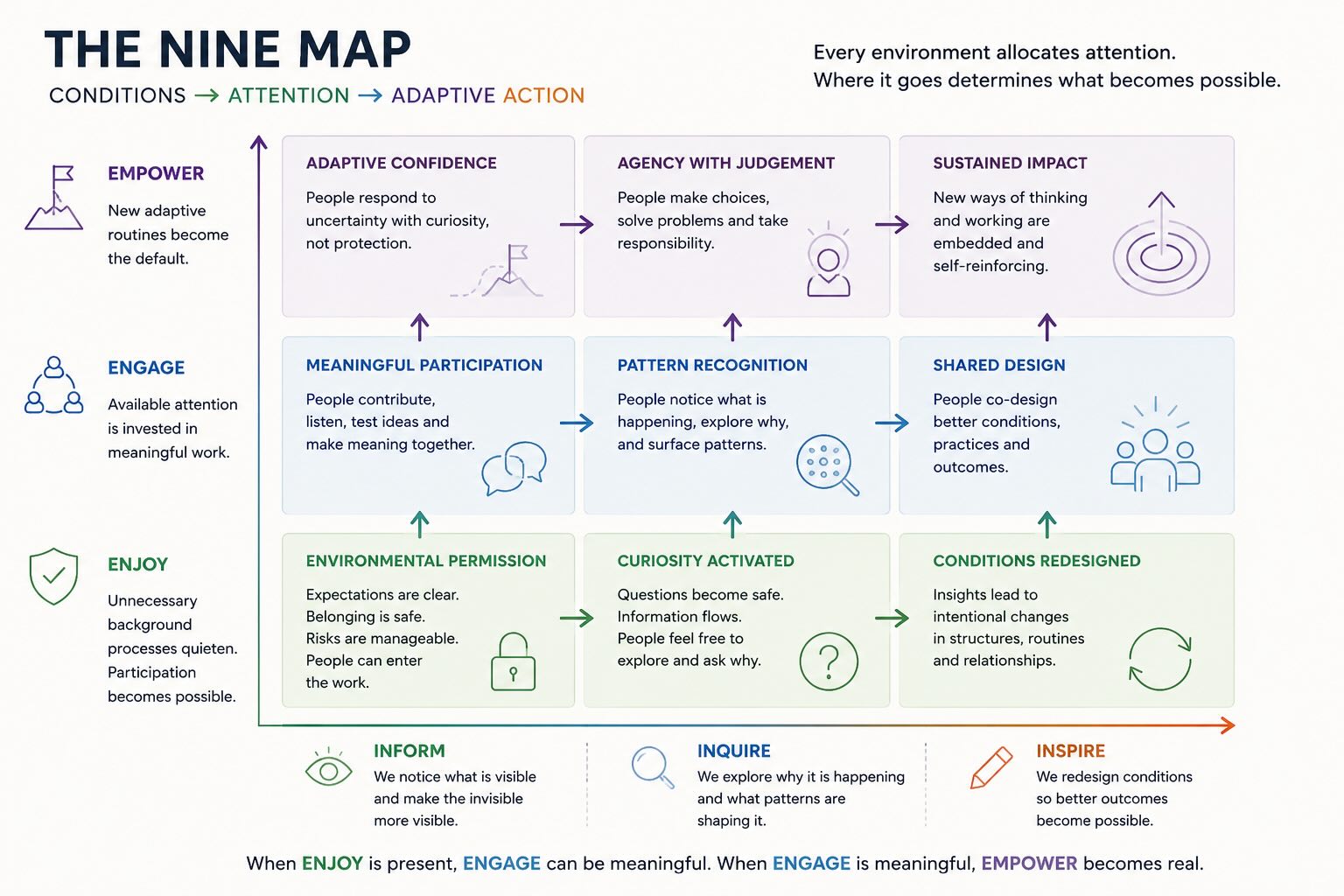
The horizontal axis describes design intent: how an environment creates orientation, redirects attention and expands possibility. The vertical axis describes adaptive response: how cognitive cost is reduced, attention becomes invested and agency begins to emerge.
The Nine Map is not a taxonomy of people. It is a map of how designed conditions shape attention, participation and agency.
Enjoy
This is why attention must be protected first.
Not because schools should be entertaining.
Not because challenge should disappear.
Because the hand rarely rises while the child is still protecting themselves.
Because the question rarely appears while the adult is still reading the room.
Because participation becomes possible when unnecessary background processes begin to quieten.
Enjoy is the condition in which attention is no longer consumed by unnecessary social risk, status monitoring, or unpredictable friction - so it becomes available for thinking.
This is not about making learning easier.
It is about removing irrelevant difficulty.
Don't reduce conceptual challenge. Reduce social uncertainty.
Don't reduce intellectual rigour. Reduce performative pressure.
Don't reduce responsibility. Reduce identity threat.
Don't reduce accountability. Reduce unnecessary exposure.
Engage
Activity can be loud.
Engagement is often quieter.
A child changes an answer.
A group argues about a better word.
A teacher tests a new routine even though the old one is easier.
A board member asks the question before the meeting has moved on.
Attention has moved.
Not towards performance.
Towards the work.
Empower
At first, agency takes effort.
The child has to risk the answer.
The teacher has to risk the experiment.
The leader has to risk the question.
The board has to risk the pause.
Then, if the environment keeps rewarding the better adaptation, something changes.
The child asks.
The teacher adjusts.
The leader names the uncertainty.
The board slows down before approving.
No speech about agency made this happen. Attention expanded beyond the immediate task into responsible initiative.
The operating system changed what felt useful.
The child who lowered their hand.
Later, in a different classroom, they ask.
Inform. Inquire. Inspire.
Meaningful change does not always follow a fixed sequence. But three design functions recur.
Inform creates orientation.
Inquire redirects attention towards what was previously invisible.
Inspire expands the possibility space so that new futures become thinkable.
These functions can reinforce one another, and the appropriate starting point depends on what the situation requires.
One useful discipline is to notice before judging or diagnosing.
Why is this happening?
What conditions make this behaviour useful?
What pattern keeps repeating?
Curiosity creates better grounds for redesign.
Not the person.
The environment.
Teachers notice before they intervene.
Leaders notice before they decide.
Boards notice before they govern.
Learning itself begins by noticing patterns before reorganising them into understanding.
This is not simply a communication model.
It is a design discipline.
The Nine Map
Participation begins before performance.
Most schools design for activity. Better systems design for participation.
Agency is not given. It emerges from repeated successful participation.
The map connects design intent with adaptive response. Each square is a hypothesis about what a particular design move might make more possible.
Inform × Enjoy: How do we provide clarity without increasing self-protection?
Inquire × Enjoy: How do we build understanding without increasing social risk?
Inspire × Enjoy: How do we create confidence without creating false certainty?
Inform × Engage: How do we provide clarity that helps people focus on the work that matters?
Inquire × Engage: How do we build understanding that deepens engagement with the work?
Inspire × Engage: How do we create direction that sustains meaningful effort?
Inform × Empower: How do we provide enough clarity for people to act confidently within clear boundaries?
Inquire × Empower: How do we build understanding that strengthens judgement and initiative?
Inspire × Empower: How do we create confidence for people to shape the wider system?
Until now we have been looking at stories.
This is the map those stories have been quietly drawing.
At first glance it looks like a framework. It is better understood as a map.
The horizontal axis describes design intent: creating orientation, redirecting attention and expanding possibility.
The vertical axis describes adaptive response: reduced cognitive friction, attention invested in meaningful work, and the emergence of agency.
Every Synnovate deck is simply a different lens on this same movement.
The Nine Map was never intended to classify people.
It was created to make movement visible.
Inform creates orientation. Inquire changes perception. Inspire expands what people believe is possible.
Enjoy creates the conditions where participation becomes possible.
Engage invests available attention in meaningful work.
Empower emerges when new adaptations become more useful than old protective routines.
Two dimensions. One movement.
Deeper reading
Designing What Matters - Inform, Inquire, Inspire, Enjoy, Engage, Empower. The full conceptual architecture behind the Nine Map.
The Work
Schools do more than deliver learning, leadership or governance.
They create conditions to which people continually adapt.
Those adaptations shape what becomes possible.
Not by lowering standards.
By removing unnecessary barriers.
Not by demanding confidence.
By making participation a rational choice.
Not by asking people to become different.
By changing what the environment repeatedly teaches them to become.
Three levels of the framework
Principles - What fundamental questions must every learning environment answer?
Design Lenses - What kind of thinking are we trying to create?
Practices - What will we actually do?
The different decks give precisely the practices that operationalise each lens. The Learning Deck makes learner adaptations visible. The cards make them discussable. The workshops make redesign practicable.
Adapting to Conditions
People are remarkably adaptive.
Sometimes they adapt to conditions that no longer exist.
Every classroom teaches more than content.
Every meeting teaches more than agenda items.
Every board teaches more than policy.
Every environment quietly teaches people how to participate.
The question is not only what people learn.
It is what the environment is teaching them to become.
Synnovate is not built around a collection of frameworks.
It is built around one recurring observation: people adapt to the environments they experience.
The Nine Map is simply a way of making those adaptations visible, discussable and redesignable.
See what is happening.
Inform.
Become curious.
Inquire.
Design better conditions.
Inspire.
Not by asking people to become different.
By changing what the environment repeatedly teaches them to become.
What this means for learning
Learning is the process of making connections that deepen understanding, build capability and strengthen the ability to think, act and adapt independently over time.
Every learner is making two kinds of connections at the same time.
One connects ideas to ideas.
The other connects experience to expectation.
What happens when I am uncertain?
What happens when I am wrong?
What happens when I disagree?
What earns approval?
What attracts attention?
These invisible connections often become more durable than the curriculum itself.
External environment
Allocates attention
Creates experience
Produces adaptation
Becomes identity
Shapes future attention
The Learning Deck exists to help teachers notice and intentionally design both kinds of connection. The Nine Map makes learner adaptations visible. The cards make them discussable. The workshops make redesign practicable.
Learning Deck & Praxis Deck
Nine learner profiles. One diagnostic question: what is this environment teaching this learner to become? Praxis makes those insights actionable in the classroom.
Lead Deck & Team Deck
The same lens applied to leadership - what adaptations are being produced around this table? Team Deck extends the inquiry to collective habits.
Board Deck
Governance as environmental design. The vertical axis shifts from individual learning to collective stewardship: Enjoy becomes the constructive conditions for candour, Engage becomes attention invested in what matters, and Empower becomes responsible agency across the board.
Dynamics Deck
When adaptive routines become dysfunctional - the same operating system under pressure.
The tools are different. The lens is the same. Make the hidden operating system visible, so that better adaptations become possible.