Induction Guide
Plans Deck
Six short sessions that walk through the PLANS framework — Problem, Look, Assess, Navigate, Systems — for thinking before acting. Pick a card to start.
Sessions 2–7 are available to registered purchasers — tap a locked card to enter the access password.
This session is locked
Sessions 2–7 are available to registered purchasers of the Plans Deck. Enter your access password to read this and the other locked sessions.
Don't have a password? Email nik@learning-deck.com.
Session 01 · Open
Start here — Orientation
What this deck helps you do, and how the cards fit together. 20–30 minutes.
Before you begin
Think of a decision you're facing — something unclear, something with competing priorities, something where the answer isn't obvious. This is where this deck is used.
What this deck helps you do
Most poor decisions aren't caused by lack of effort. They're caused by:
- unclear problems
- narrow perspectives
- rushed actions
- lack of follow-through
This deck helps you think clearly before acting.
What's in the deck
You'll notice four types of cards:
PLANS cards
Structure. Five letters that organise disciplined decision-making: Problem, Look, Assess, Navigate, Systems.
Tactic cards
Decision moves. Specific ways to think within each PLANS stage.
Inquire cards
Reflection. Questions to deepen thinking and challenge assumptions.
Scenario cards
Application. Realistic decision situations grouped around tactical, strategic, and review work.
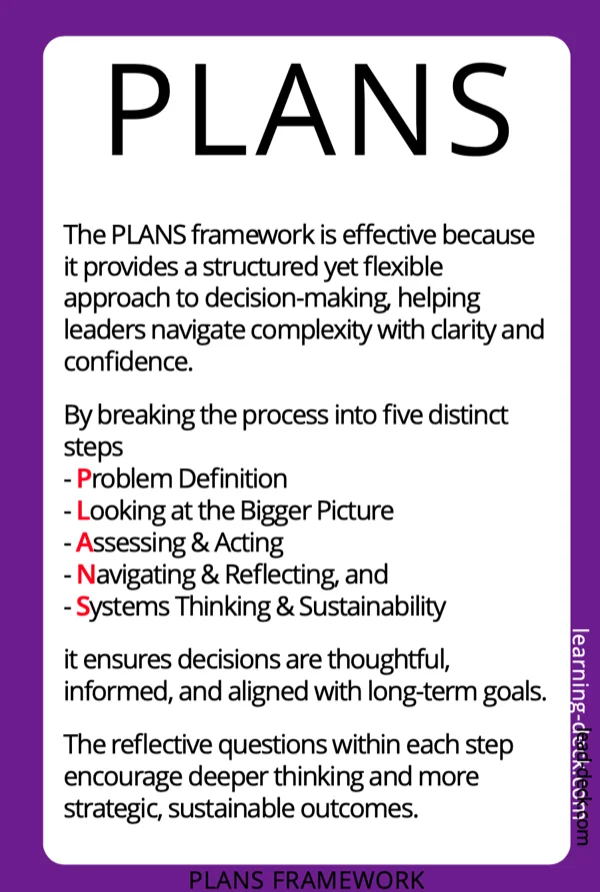
1. The structure: P.L.A.N.S. ℹ︎
PLANS is a five-part cycle for disciplined decision-making:
This isn't a linear checklist. You may move between steps. But each step matters.
2. Tactic cards ℹ︎
Tactic cards are aligned to each PLANS step. They provide specific ways to think, structured decision moves, and practical ways to move forward. They answer: "How do I think better at this stage?"
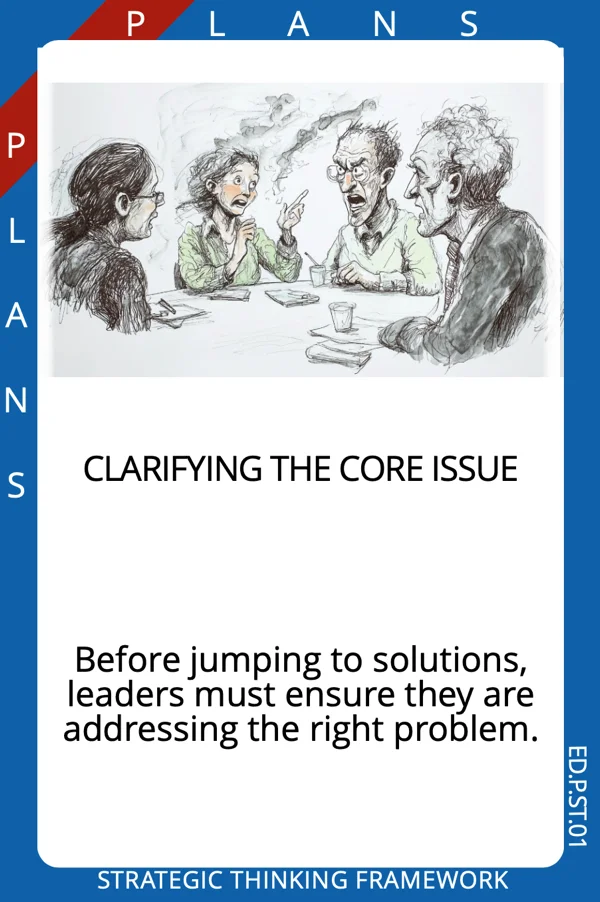
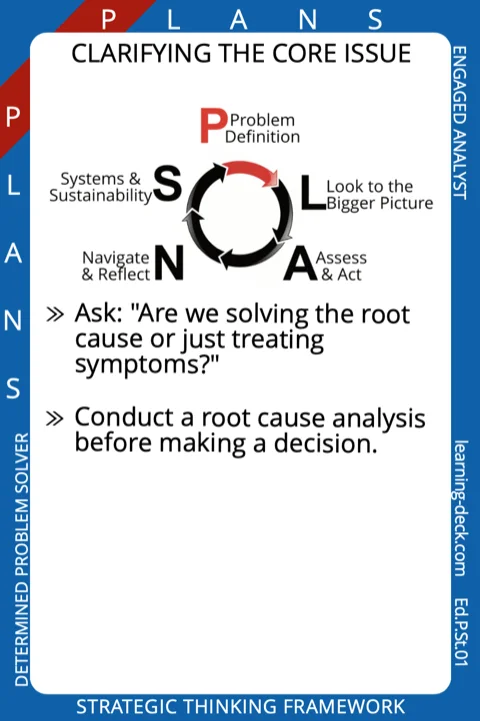
Each tactic card has a front (the move) and a rear (prompts that anchor it in real thinking). You don't need many — one well-chosen tactic is more powerful than many loosely applied ones.
3. Inquire cards ℹ︎
Inquire cards offer focused questions, deeper reflection, and challenges to assumptions. They help you avoid shallow or rushed thinking.
4. Scenario cards ℹ︎
Scenarios are grouped around key decision areas — tactical decision-making, strategic thinking, planning & risk, prioritisation & resources, decision review & learning. They allow you to apply thinking to realistic situations.
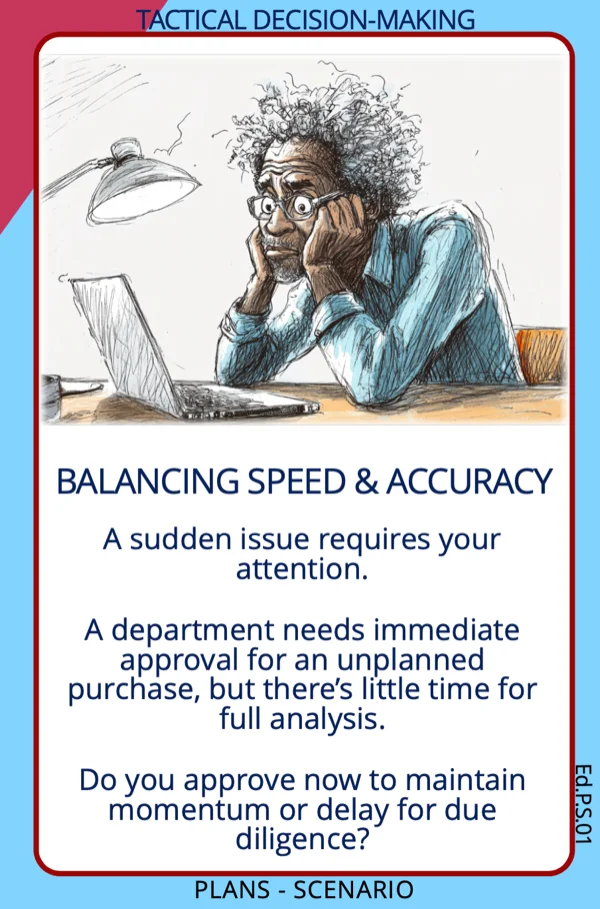
These are not case studies to solve. They are tools to practise thinking without pressure.
How it fits together
- PLANS → provides structure
- Tactics → guide thinking within each stage
- Inquire → deepens reflection
- Scenarios → test application
One line to hold
Clarity before action. Learning after action.
Where this deck fits in the suite ℹ︎
This deck answersHow do we make better decisions?
Across all eight: make the invisible visible → choose deliberately → act precisely → reflect and adapt.
Where to go from here
You've now seen the four card types and the five-letter PLANS framework. That's enough to start with. The next session takes you into the first letter — P (Problem Definition) — with a real decision in mind.
If you're leading a team
- Don't start with all five stages — that's a process, not a development experience
- Start with a real decision. Clarify the problem together.
- Introduce one or two PLANS stages
- Use tactics to guide thinking within those stages
Avoid: rushing to solutions · using too many tactics · treating this as a checklist.
Other decks help you understand people and situations. This deck helps you decide what to do about them. The next session takes you into your first practical PLANS exercise.