Ask a leadership team to describe their school's culture and you'll get adjectives. Supportive. Inclusive. High-performing. Ambitious. The words are genuine - nobody is lying. But they rarely describe the same thing. One person means "staff feel safe to speak up." Another means "behaviour in corridors is calm." A third means "we get good results." Same word. Different internal pictures.
This isn't a failure of communication. It's a failure of definition. Culture is one of the most powerful forces in any school, and arguably one of the least understood.
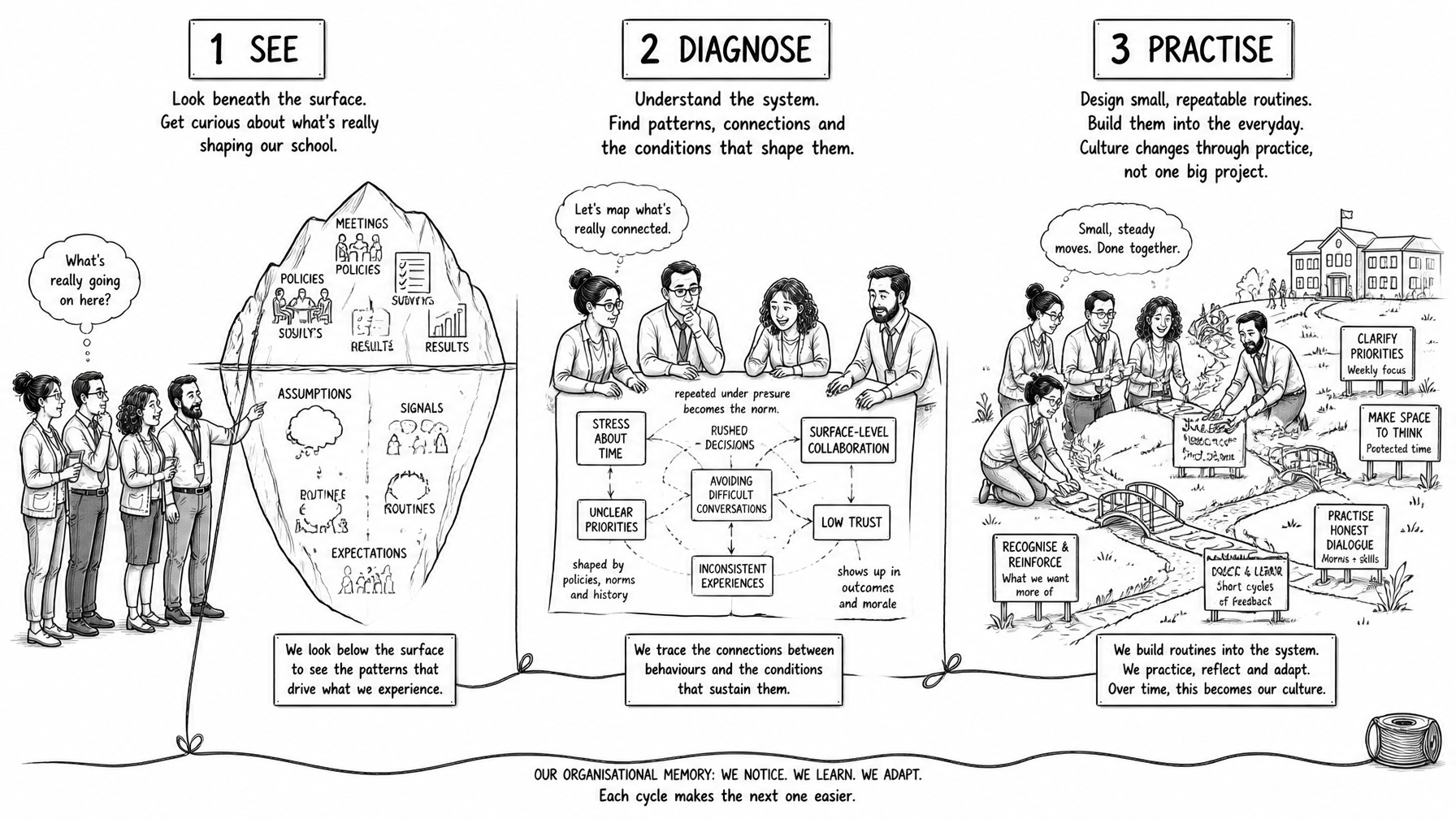
What the research actually says about culture
The mistake is that we often treat culture as shared values. Increasingly, research suggests something different: culture is shared adaptation.
Edgar Schein, who spent his career studying organisational culture, defined it not as values or beliefs but as "a pattern of shared basic assumptions that was learned by a group as it solved its problems of external adaptation and internal integration." The key word is learned. Culture is not installed. It accumulates. It is the residue of repeated experience.
Amy Edmondson's work on psychological safety made the same point from a different angle. Teams don't become psychologically safe because a leader declares it. They become safe, or unsafe, through repeated interactions that teach members what happens when they speak, question, or admit error. Each interaction is a data point. Over time, the data forms a conclusion. That conclusion becomes behaviour.
Karl Weick's sensemaking research describes how people in organisations construct meaning retrospectively. They act, then interpret what their action means, then act again based on that interpretation. Culture is the accumulated weight of those interpretations. It is not what the school says it believes. It is what experience has taught people to expect.
Argyris and Schön's double-loop learning framework identified why organisations so often fail to change: they fix problems within existing assumptions without ever examining the assumptions themselves. A school that says "we need better communication" is operating within single-loop learning, adjusting behaviour. A school that asks "what have we taught people to expect when they communicate?" is operating at double-loop, examining the conditions that produced the behaviour.
Donella Meadows' work on systems showed why surface interventions often disappoint: changing visible structures has less leverage than changing the rules, information flows, and assumptions that produce behaviour.
People adapt to the environment they experience. Repeated adaptations become habits. Shared habits become culture.
Why most culture work doesn't work
Schools invest enormous energy in culture, both directly and indirectly. They write value statements. They run wellbeing surveys. They hold INSET days on "our ethos." They might even commission culture reviews. Most of this investment targets the wrong layer.
Value statements target what people believe. But people can believe one thing and adapt to another. A teacher who genuinely values collaboration will stop collaborating if experience teaches them that collaboration costs them time and yields no benefit. The belief hasn't changed. The adaptation has.
Culture surveys target what people say. But people report their experience through the lens of their expectations. Reports matter, but they're not the culture itself. They're another signal produced by the culture. A staff that has learned caution may report satisfaction because expectations have adjusted. The question isn't only "what did people say?" but "what conditions shaped what became safe to say?"
INSET days target what people know. But knowledge doesn't change behaviour unless the environment changes alongside it. A training session on feedback techniques is irrelevant if the school's meeting culture makes honest feedback professionally dangerous.
The problem isn't that schools don't care about culture. The problem is that culture operates at a layer most schools don't know how to reach, and which is harder still to measure: the layer of inferred rules, unspoken permissions, repeated signals, and accumulated adaptations that sits beneath every stated value.
The three capabilities a school actually needs
If culture is shared adaptation, then changing culture requires three things, not one.
First, the capacity to see the operating system. Before a school can change its culture, it has to see the conditions producing it. Not the stated values. Not the survey results. The actual signals, permissions, frictions, and constraints that shape what people do every day. This is harder than it sounds, because the operating system is invisible to the people inside it. They have adapted to it. It feels normal.
Second, the capacity to diagnose a pattern. Once the operating system is visible, the school needs to examine a specific pattern in detail. Not "our culture needs to improve." A specific recurring behaviour: the initiative that keeps stalling, the meeting that generates agreement without ownership, the feedback that gets collected but never acted on, and a precise diagnosis of what the system is assuming that makes that pattern rational.
Third, the capacity to install new habits. Seeing the system and diagnosing the pattern are necessary but not sufficient. Culture doesn't change because people understand it. It changes because people practise something different, repeatedly and deliberately, until the new practice becomes the new normal. And this requires more than intention. It requires a protocol: a simple, repeatable routine that can be embedded into how the school already works.
These three capabilities, seeing, diagnosing, installing, are not things schools typically develop. They are things schools typically outsource. A consultant sees. A report diagnoses. A training day installs. And then the consultant leaves, the report sits on a shelf, the training fades, and the operating system continues producing the same adaptations it always produced.
The language problem
There's a deeper challenge beneath all of this. Even if a school develops the capacity to see its operating system, it needs a language to describe what it sees.
Without a shared language, observations become personal opinions. "I think people don't feel safe to speak up" is an opinion, easily dismissed, easily attributed to the speaker's perspective. "The environment is sending a signal that speaking up carries cost" is a diagnosis, harder to dismiss, because it describes a condition rather than a feeling.
The difference between opinion and diagnosis is language. And most schools don't have the language. They have value statements and survey results and improvement plans, but they don't have words for friction, permission architecture, inferred rules, false consensus, the hidden signals that shape behaviour, and the invisible layer beneath every visible metric.
This isn't a vocabulary problem. It's a capability problem. Without the language, the operating system remains invisible. With the language, it becomes discussable. And what is discussable can be changed. Professions advance when they develop better distinctions. A doctor doesn't see "someone feeling unwell"; they see symptoms, systems, and possible causes. The vocabulary increases what can be noticed.
What this looks like in practice
The shift from "we need to improve our culture" to "we can see the conditions producing our culture and we know how to practise something different" is not a single step. It is a sequence.
A leadership team that has developed the capacity to see its operating system walks into a meeting and notices something it would have missed before. The same three people speak. The same items receive detailed attention while others are nodded through. The same corridor conversations happen afterwards, the ones that are sharper and more honest than anything said in the room.
Before the shift, this would have been experienced as frustration. After the shift, it is experienced as data. The team can name what it sees: the meeting is deciding who speaks before it even begins. Three people will talk. Everyone else will listen. This pattern doesn't only belong to the people in the room. It belongs to the conditions the room repeatedly creates.
A team that has developed the capacity to diagnose a pattern can take that observation further. It can ask: what is the system assuming that makes this rational? And it can trace the consequences: what behaviour has become normalised? What has the organisation stopped being able to do? Who quietly carries the weight?
A team that has developed the capacity to install new habits can then act, not with a grand initiative, but with a single protocol. One question asked at the start of every meeting. One routine practised for four weeks. One guardian who asks at the end: "did the protocol hold?"
This isn't culture change as schools typically attempt it. It is slower. Smaller. More precise. And it works, because it operates at the layer where culture actually lives.
The implication
Culture isn't mysterious. It isn't intangible. It isn't a matter of values, vision, or leadership charisma.
Culture is what the environment teaches people to expect, and how to respond. And environments can be designed.
The question is not "what kind of culture do we want?" The question is "what does our school currently teach people to expect, and what would we need to practise differently to teach something else?"
Answering that question requires three things most schools don't yet have: the capacity to see the operating system, the language to describe it, and the habits to strengthen it. This is why culture work cannot remain a presentation, a survey, or a report. The capability has to move into the organisation itself. Schools need people inside the system who can notice patterns, name what is happening, and introduce better routines.
Culture remembers. The question is what you want it to remember, and whether you're willing to practise until it does.
The three capabilities described here - seeing, diagnosing, installing - are built experientially across a linked arc of Synnovate workshops. Beneath the Waterline develops the capacity to see the operating system. Waterline Lab diagnoses a specific pattern in your organisation. Designing the Waterline installs the habits that make a different culture normal. A twenty-minute Culture Diagnostic reveals your school's operating patterns before the work begins.