Schools want empowered learners: students who ask questions, take ownership, lead inquiry and contribute with confidence. It's a good vision, but it often begins in the wrong place.
Every teacher has seen it. A child who knew the answer and said nothing. The answer existed. The intelligence existed. Something else was using the attention.
Who else has their hand up? What if I'm wrong? Will everyone hear? Will this slow the lesson down?
The learner is solving two problems at once: the one on the page and the one created by the environment.
The pattern doesn't disappear when we become adults. It follows us into staff meetings, leadership teams and boardrooms, where attention is still divided between the work itself and the quiet calculation of when to speak, how to contribute and what it might cost. The same human system keeps appearing in different rooms.
People are remarkably adaptive. They adapt to the environments they experience. If an environment repeatedly teaches that visible uncertainty carries a cost, people adapt accordingly. The adaptation is often intelligent, but it may also become invisible. Eventually it begins to look like confidence, personality, capability or culture when it is really a learned way of participating.
This is why the Learning Deck begins with Enjoy. Not because learning should be entertaining, but because every environment quietly allocates attention. Attention spent monitoring peers, protecting identity, decoding hidden rules or reading the room is attention that can't be invested in learning.
Enjoy is environmental permission. It reduces unnecessary background processing, not by lowering challenge but by removing irrelevant difficulty. Don't reduce conceptual challenge. Reduce social uncertainty. Don't reduce intellectual rigour. Reduce performative pressure. Don't reduce responsibility. Reduce unnecessary identity threat.
When those background processes begin to quieten, something changes. Attention becomes available. Questions appear. Ideas are tested. Mistakes are repaired. Meaning is negotiated. Engagement is not visible activity or busy classrooms. It is available attention invested in meaningful participation.
Empower comes last. Not because agency is unimportant, but because agency emerges. The learner who once lowered their hand begins to ask. The teacher who once waited for certainty experiments. The leader who once saved the question for the corridor raises it in the meeting. The board member who once kept the question in the margin asks it before the decision is made.
No speech about empowerment created that change. The environment changed what felt useful.
This is the Synnovate Lens. Not a model of people, but a way of seeing environments. Every classroom, meeting and board quietly teaches people how to participate, and every environment allocates attention. The question is rarely, "How do we empower learners?" or teachers or leaders. The more useful question is, "What is this environment quietly teaching people to run in the background?"
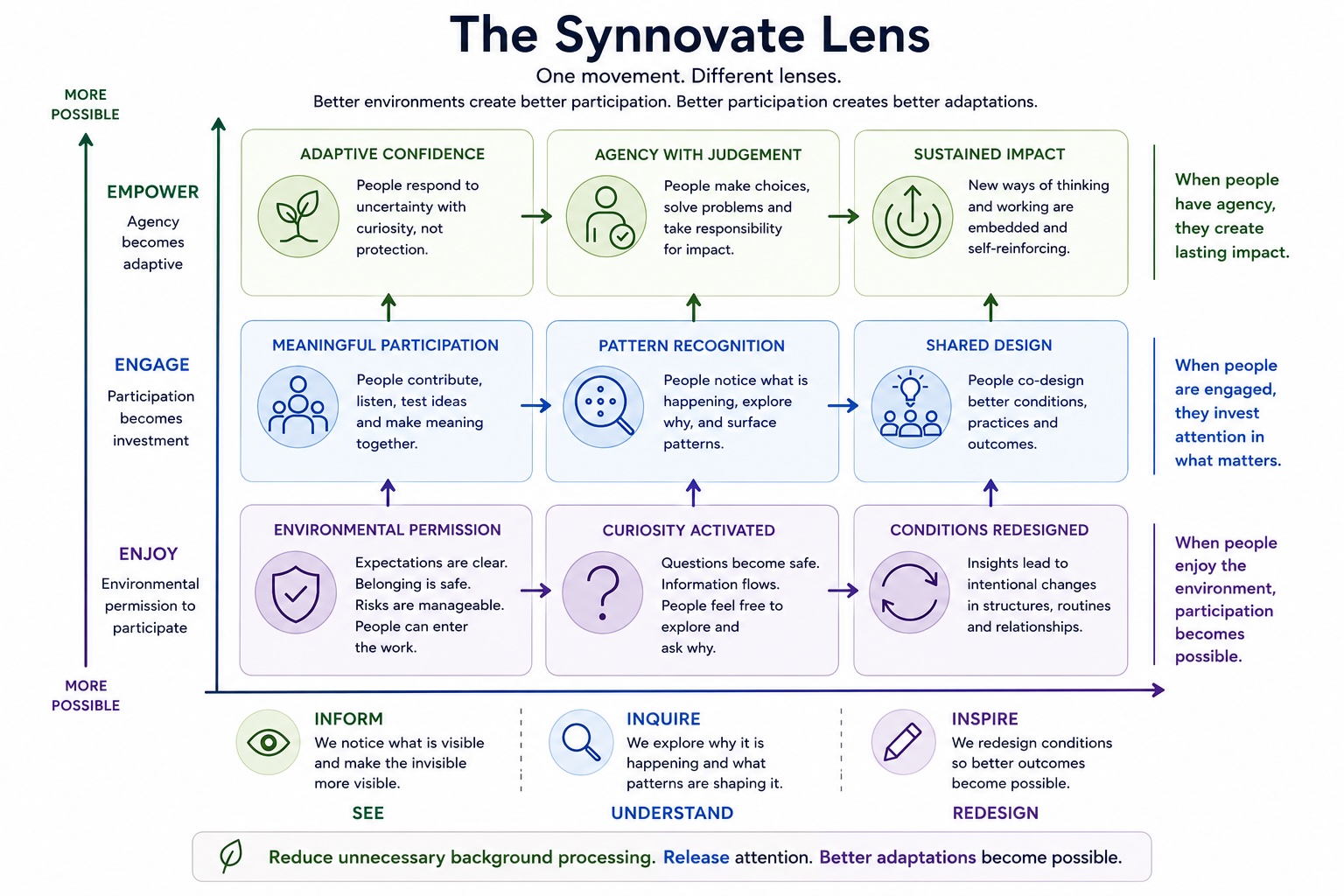
That shift in perspective changes the work. Instead of trying to fix people, we begin designing better conditions. Instead of demanding confidence, we reduce unnecessary self-protection. Instead of asking for more engagement, we ask where attention is currently being spent.
Every classroom teaches more than content. Every meeting teaches more than agenda items. Every board teaches more than policy. The deepest work of education, leadership and governance is to design environments where attention is invested in meaningful work rather than unnecessary self-protection.
Agency is rarely the first move. It is usually the consequence of a well-designed environment.
Deeper reading
Designing What Matters — the full architecture behind Enjoy, Engage, Empower and their relationship to Inform, Inquire, Inspire.