Quite naturally, schools want more learning, more inquiry, more confidence, and more contribution.
Schools and organisations want the same from adults - better thinking in meetings, more honest dialogue, stronger ownership, clearer judgement.
So they build more structure:
- more presentations
- more reporting
- more public discussion
- more performance evidence
- more participation requirements
- more accountability moments
Some of this is useful. Schools need clarity. Leaders need evidence. Students and adults both need direction.
But there is a quiet problem.
The same structures that make participation visible can also make self-protection more attractive.
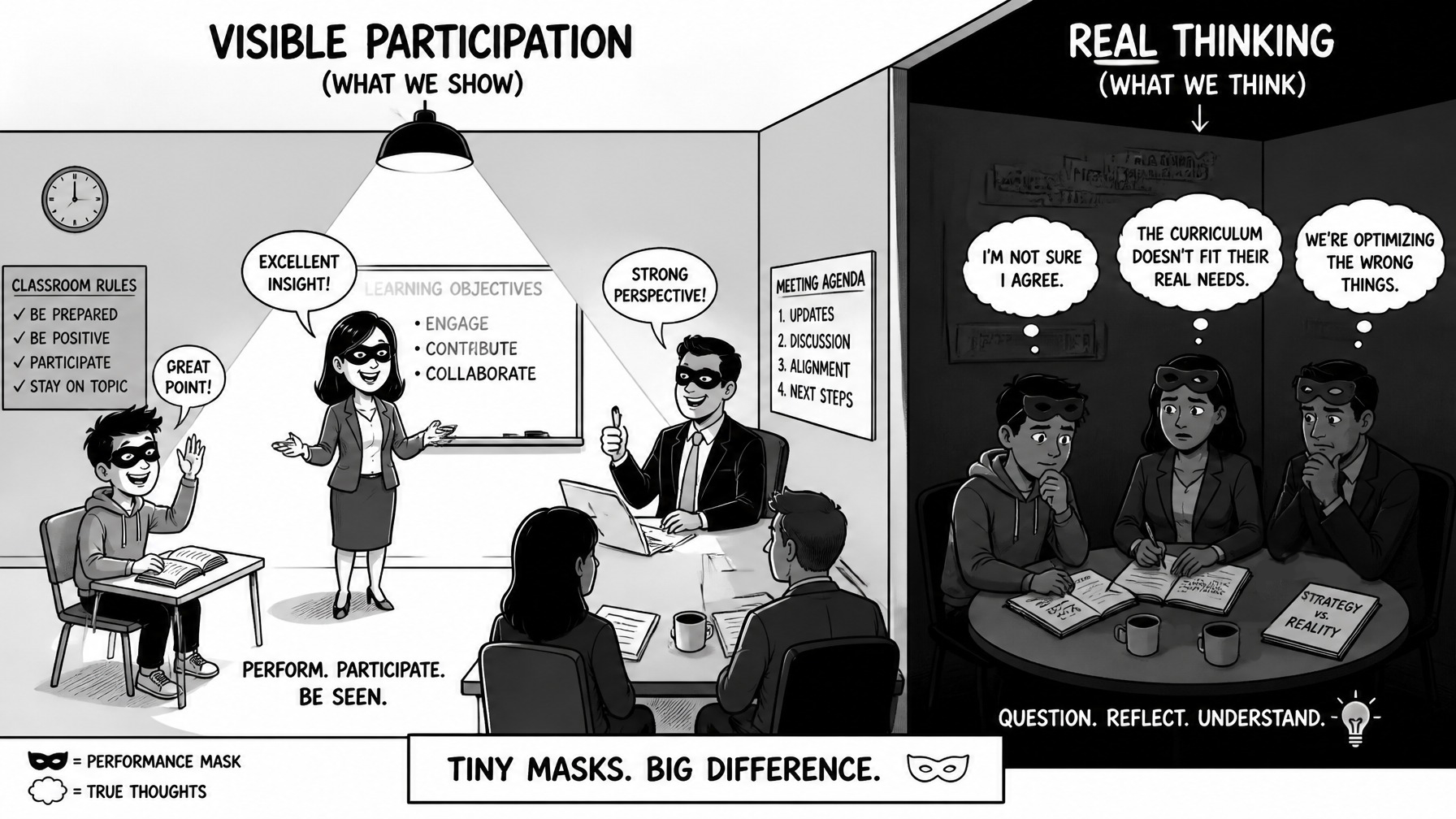
When people feel watched, compared, corrected, or politically exposed, they do not always stop participating. Often they continue — but more carefully. They give safe answers. They wait for signals. They say what sounds acceptable. They avoid unfinished thought.
From the outside, the system still looks active.
People are speaking. Students are responding. Teachers are attending professional learning. Leaders are contributing in meetings. Board members are discussing strategy.
But the quality of thinking has changed.
The environment has shifted people from exploration into performance.
The student who waits to hear three other answers before raising their hand. The teacher who attends the training, nods throughout, and returns to familiar practice. The board member who raises the concern privately after voting publicly.
Different roles. The same calculation underneath.
Visibility is not the same as learning
This distinction matters.
A student can answer a question without feeling free to test an idea. A teacher can attend training without changing practice. A leadership team can discuss a problem without naming the real tension. A board can receive information without developing deeper understanding.
In each case, visible activity continues. But thinking — the uncertain, exploratory kind — has quietly narrowed.
This is not because people are dishonest or unwilling. It is because human cognition is sensitive to conditions.
We think differently when our identity feels safe. People speak more honestly when uncertainty is tolerated. Mistakes stop feeling dangerous.
The issue is not whether schools should have structure. They should.
The issue is what kind of structure creates meaningful participation rather than performative participation.
The same pattern appears everywhere
In language learning, a child may acquire useful phrases quickly through play, need, and social interaction. The child wants to join a game, borrow something, ask for help, or understand what is happening.
The language has purpose before it has perfection.
In a formal classroom, the same child may become silent — not because they have lost the ability to learn, but because the risk has changed. The sentence is no longer only communication. It is now evidence. It may be corrected, compared, graded, or noticed by peers.
Something similar happens in meetings.
A leader may have real doubts, useful questions, or a half-formed insight. But if the room rewards confidence, alignment, and political skill, that person may protect themselves instead. The meeting continues. The agenda moves forward. The real thinking may happen later — in corridors, smaller groups, or private messages.
Different setting. Same human system.
Evaluation pressure increases. Self-protection rises. Exploration decreases.
The deeper question is environmental
The same tension keeps appearing in very different places — classrooms, leadership teams, governance meetings, professional learning. Different settings, different stakes, but the same underlying problem:
What conditions allow people to think, learn, contribute, and inquire without having to defend their identity at the same time?
The Learning Deck helps schools make learning visible through shared language and structured reflection. The Lead Deck helps leaders notice how their stance under pressure shapes the system around them. These are not separate conversations. They meet at the level of conditions.
If the environment teaches people to protect themselves, empowerment becomes difficult.
If the environment makes uncertainty unsafe, inquiry becomes performative.
If visible compliance is rewarded more than honest thinking, the system can look healthy while real thinking narrows underneath it.
A better aim
The goal is not to remove challenge.
It is not to make classrooms easy or meetings comfortable.
The goal is to design environments where challenge does not immediately become identity threat.
That means paying attention to:
- how people enter a conversation
- whether approximation is allowed
- where mistakes become public
- how status shapes participation
- whether silence is treated as thought, refusal, fear, or strategy
- whether people can contribute before they are fully certain
This is where the sequence of Enjoy, Engage, and Empower becomes important.
Enjoy is not entertainment. It is emotional permission, participation safety, and relational trust.
Engage is not surface activity. It is meaningful participation in shared work.
Empower is not simply giving people more responsibility. It is the agency that becomes possible after safety and participation are already present.
Many systems try to begin with empowerment.
They ask students to inquire before they feel safe to approximate. They ask teachers to innovate before the culture can hold uncertainty. They ask leaders to speak honestly before the room has made honesty structurally possible.
The result is not empowerment. It is performance under pressure.
The same structures built to make learning visible have made self-protection the more rational choice.
The question is not only: are people participating?
It is: what kind of participation has this environment made possible?