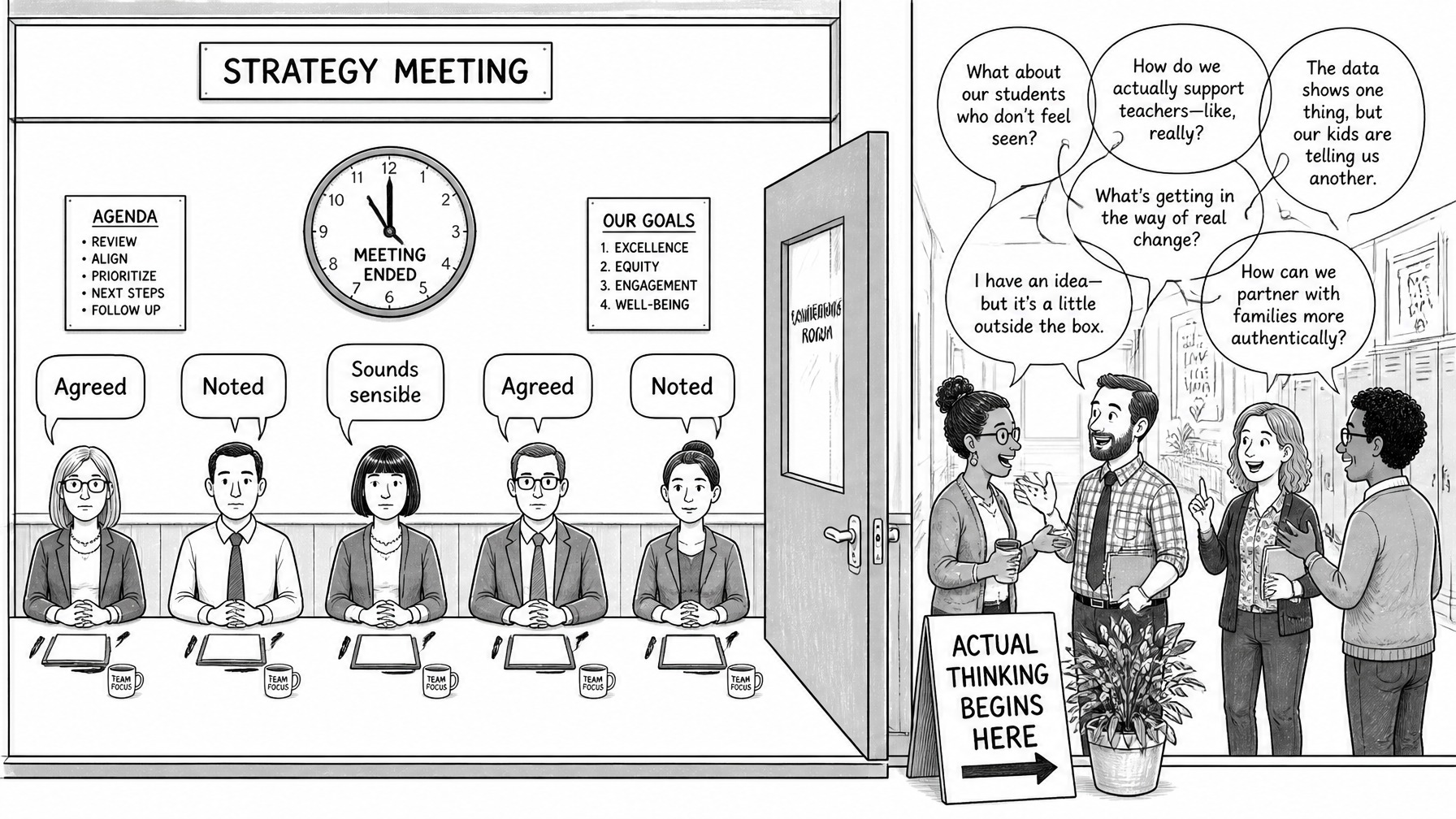
You leave a meeting. You're walking back to your classroom or office. Someone falls into step beside you.
"Can I just say something?"
And what they say is sharper, more honest, and more useful than anything said in the previous hour during the meeting.
Every school has this moment. After the SLT meeting, someone quietly names the tension that filled the room. After the staff briefing, a teacher admits they didn't understand the new initiative and suspects nobody else did either. After the governors' meeting, someone checks whether anyone else noticed the risk in the proposal.
This corridor conversation is not a failure of process. It is information. The question it raises is this: why did the best thinking happen after the meeting ended?
Meetings are social environments before they are thinking environments
When people speak in a meeting, they are processing more than the agenda. They are managing identity, status, relationships, authority, and risk.
Can I say this without sounding negative? Will this be heard as resistance? Will I be the only one who says it? Will this follow me afterwards?
These questions run quietly underneath every agenda item. So people learn to participate safely - contributing enough to be involved, but not enough to be exposed. They ask careful questions. They agree in general terms. They hold the sharper thought for later, for the corridor, for someone they trust.
This is not dishonesty. It is adaptation. The environment has taught them what kind of contribution is welcome - and what kind carries cost. They are responding to signals, not to the stated purpose of the meeting.
Two patterns that keep meetings stuck
Performative alignment
The room appears to agree because disagreement feels expensive. Everyone nods. The minutes record consensus. But underneath, people hold different interpretations, different concerns, different levels of commitment.
The cost appears later - not as open resistance, but as slow follow-through, inconsistent messaging, repeated clarification, quiet avoidance, and initiative drift. The meeting looked aligned. The system was not.
Strategic ambiguity
People use language that sounds thoughtful but keeps the real issue just out of reach. "We may need to look at that." "There are some concerns." "It depends on the context." Sometimes this language is exactly right - complex situations need nuance. But sometimes it protects the speaker from naming a position, and the room receives words without enough clarity to think with.
In both patterns, nobody is obstructing. Nobody is lying. But the conversation never reaches the level where judgement can improve.
What the research says - and what it misses
The research on meeting effectiveness tends to focus on structure: clear agendas, defined roles, time discipline, action tracking. All of this is useful. None of it addresses the deeper problem.
Psychological safety (Edmondson, 1999) gets closer. Teams perform better when people feel safe to speak up, admit uncertainty, and challenge assumptions. But psychological safety is not a protocol you can add to a meeting agenda. It is a condition the environment either provides or doesn't - built or eroded over dozens of meetings, through hundreds of small signals about whose voice is welcomed, whose concern is taken seriously, and what happens to the person who names the uncomfortable thing.
Sensemaking (Weick, 1995) adds another layer. People do not simply receive information in meetings. They interpret it - actively, socially, and often unconsciously - through the lens of their role, their prior experience, and their perception of what is at stake. The same agenda item means different things to the headteacher, the head of department, and the classroom teacher. They extract different cues. They construct different narratives. And the meeting has no mechanism for surfacing those differences - so it treats silence as agreement and moves on.
Double-loop learning (Argyris & Schön, 1978) provides the sharpest diagnostic question. Single-loop learning asks: "How do we make this meeting more efficient?" Double-loop learning asks: "What is it about this environment that makes honest thinking feel costly - and what would need to change for it to feel natural?"
Most schools never reach the second question. They add structure. They tighten agendas. They introduce protocols. And the corridor conversation keeps happening - because the underlying conditions haven't changed.
The waterline in your meeting room
Every meeting has a waterline.
Above it: the agenda, the minutes, the action points, the visible structure. The layer that looks professional. The layer that can be reported to governors or inspectors.
Below it: who speaks and who doesn't. What questions feel safe. What disagreement was softened. What tension was named privately afterwards. What assumptions everyone shares but nobody has tested. What the meeting is actually teaching people about what kind of contribution counts.
The things below the waterline shape every decision made above it. And they are invisible to the tools most meetings use to evaluate themselves. A smooth agenda and completed action points tell you the meeting ran efficiently. They tell you nothing about whether it improved the quality of shared judgement.
What the Lead Deck reveals
The Lead Deck identifies nine leadership profiles - the stances leaders naturally take under pressure. Some profiles create clarity but unintentionally close the room. Others keep the room comfortable but avoid the tension the conversation actually needs. Others rush to solve before the pattern has been understood.
The Relationship Builder profile is useful here because trust is not the absence of challenge. Trust is what allows challenge to become useful - without it being received as attack, resistance, or disloyalty. A leader developing this profile learns to build conditions where honest thinking feels less costly.
But individual leadership development is only half the answer. The other half is environmental: the room itself - its routines, its defaults, its signals - is producing behaviour. A skilled leader in a poorly designed meeting will still get corridor conversations. A well-designed meeting makes good thinking easier for everyone in it, regardless of their natural stance.
From diagnosis to redesign
This is where the diagnostic lens becomes practical. If your meetings consistently produce corridor conversations, performative alignment, or strategic ambiguity, the question is not "how do we get people to speak more honestly?" The question is: what is this environment teaching people about what is safe, rewarded, and costly?
Where is the friction? Is the agenda so full that real discussion is the first thing cut? Are papers circulated too late for anyone to think before they arrive?
Who has permission? Do the same three voices dominate every meeting? Who has never spoken - and what has the room taught them about whether their voice is welcome?
What signals are people reading? When someone raises a concern, is it treated as a contribution or an obstruction? What happened the last time someone named a risk early?
Do we share meaning? When the room agrees on "high expectations" or "student agency" - do six people mean six different things?
What's below the waterline? What would the corridor conversation tell you that the minutes cannot?
What behaviour is this environment producing? If a new staff member attended three meetings, what would they learn about how to participate - and what to keep to themselves?
A better question
The quality of a meeting is not proven by how smoothly it runs.
Some smooth meetings are simply well-managed avoidance. The agenda was cleared. The minutes were taken. Nobody was uncomfortable. And nobody's thinking improved.
The better question is: did the meeting improve the quality of shared judgement?
If it did, you probably saw something slightly uncomfortable but useful happen. Someone revised a view. Someone asked a question they didn't know the answer to. Someone named a risk before it became a crisis. Someone made the room think better than it would have done alone.
That is a meeting doing real work.
The diagnostic lens described here is taught experientially in two Synnovate workshops. Beneath the Waterline builds the capacity to see hidden operating systems through six lived encounters. Waterline Lab applies that lens to your organisation's actual recurring problems - including meeting dynamics. A twenty-minute Culture Diagnostic reveals your team's operating patterns before the workshop begins.