I was reading a school strategic plan recently and found myself increasingly uncomfortable, though not because it was badly written. Quite the opposite, in fact. The plan began with three beautifully simple ideas: Our growth comes from learning, our purpose from serving, and our strength from connecting. Three priorities followed - Agency, Service and Belonging. Clear, memorable, coherent.
Then came the measures.
One definition of agency described students taking purposeful initiative, developing a plan and following it through. But one of the measures of success was whether students agreed that the written curriculum was accessible and easily understood, with an eventual target of 100%.
Now, there’s nothing inherently wrong with knowing whether students can access the curriculum. But imagine the result reaches 100% and nothing else about student learning changes. Would we really conclude that students had become more agentic? Probably not.
Now reverse the question. Imagine students become demonstrably more independent, purposeful and capable of directing their own learning - but the curriculum-access measure remains stubbornly below target. Would we conclude that the strategy had failed? Again, probably not.
That tells us something important. The problem isn’t necessarily the measure. The problem is the relationship between the measure and what we claim matters. And that’s the problem I’ve been trying to get at with the 4P Coherence Framework.
Four perspectives, not four steps
4P began life as a relatively simple inquiry model: Purpose - what are we trying to make true? Process - what is shaping what happens? Practice - what is actually emerging? Proof - what does the evidence tell us?
But the more I’ve used it across strategy, governance, policy and organisational questions, the less interesting the four boxes have become. The interesting part is what happens between them. Purpose is intention. Process is design. Practice is reality. Proof is evidence. And organisational coherence depends on whether those four things can withstand being tested against one another. That produces six different tests.
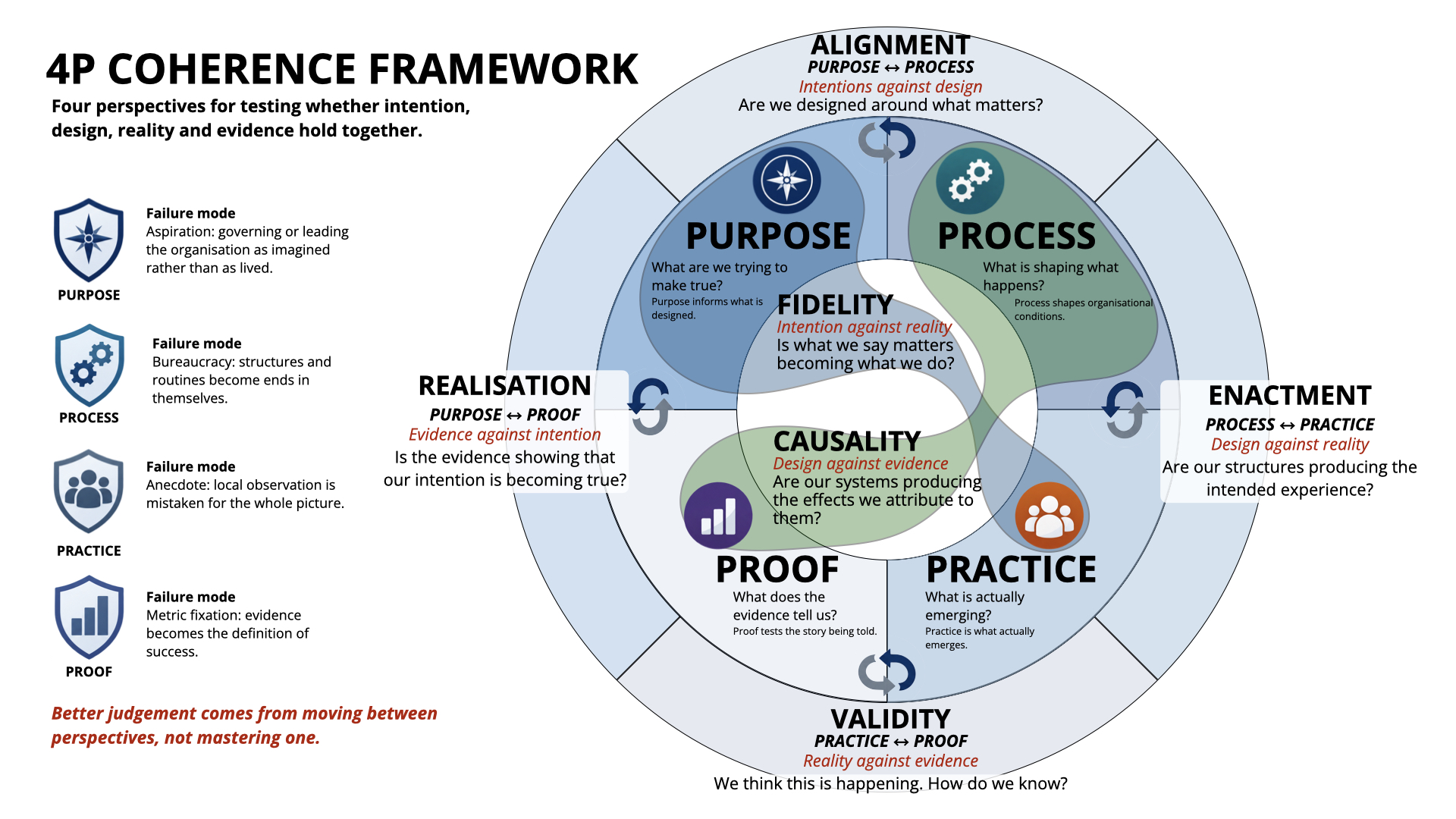
Around the framework
Start with Purpose and Process. We say something matters - but have we actually designed the organisation around it? That’s Alignment (Intention ↔ Design). A school might claim collaboration is a core value, yet its timetable gives teachers no shared planning time. The purpose is stated; the design doesn’t deliver it.
Then compare Process and Practice. We’ve created structures, systems and routines - but are they producing the experience and behaviour we intended? That’s Enactment (Design ↔ Reality). A board introduces a new governance framework designed to streamline decisions, but in practice, every item still gets escalated to the full board. The structure exists; the behaviour hasn’t changed.
Then Practice and Proof. We think something is happening - but what justifies that belief? That’s Validity (Reality ↔ Evidence). A leadership team is convinced staff morale is improving because the quarterly survey shows a positive trend - but the survey has a 30% response rate, with little evidence that respondents are representative of the wider staff. The evidence may not represent the reality.
And finally Proof and Purpose. Does the evidence suggest that what we intended is actually becoming true? That’s Realisation (Evidence ↔ Intention). A strategy prioritises student agency, and several indicators show students taking greater ownership of their learning. Notice what this test does not establish. Validity asks whether the evidence accurately represents reality; Causality asks whether our processes produced the change. Realisation makes the narrower claim: does the evidence we have support the intention we set?
These four tests follow the organisational story one relationship at a time: intention into design, design into reality, reality into evidence, and evidence back against intention. Each asks whether the next part of the story holds.
The diagonals do something different. They bypass a step and test the larger claim directly.
The diagonals are less comfortable
The first jumps directly from Purpose to Practice: is what we say matters actually recognisable in what people do and experience? That’s Fidelity (Intention ↔ Reality). A school can have an elegant mission, carefully aligned systems and extensive documentation, and still discover that the organisation as lived bears surprisingly little resemblance to the organisation as described.
The second jumps from Process to Proof: are our systems actually producing the effects we attribute to them? That’s Causality (Design ↔ Evidence). Realisation asks whether what we hoped for is becoming true - a necessary question, but a relatively comfortable one. Causality asks something harder: whether our explanation for why it’s becoming true deserves to be believed. Results improved after we introduced the programme - but did they improve because of the programme? Those are very different claims.
The danger of staying in one place
This is where 4P has moved furthest from its origins as an inquiry cycle. Each perspective is useful, but each also becomes dangerous when mistaken for the whole picture. Stay too long in Purpose and you get aspiration - leading the organisation as imagined rather than as lived. Stay in Process and you get bureaucracy - structures and routines gradually become ends in themselves. Stay in Practice and you risk anecdote - a vivid local experience becomes your account of the whole organisation. Stay in Proof and you get metric fixation - what can be measured gradually becomes what matters.
And that last one takes us back to the strategic plan. The danger of a 100% target isn’t simply that it might be the wrong number. Something more consequential can happen: Proof can start changing Practice. Once success is defined as 100% of students reporting X, the organisation has an incentive to produce X. This is a version of Goodhart’s Law: when a measure becomes a target, it tends to stop functioning well as a measure.
But in organisational terms, the problem goes further. The measure doesn’t simply become less reliable. It starts changing the practice it was supposed to observe. Proof begins to shape Practice. Questions get refined. Documentation improves. Teachers are reminded. Missing responses are chased. None of those actions is necessarily wrong. But gradually the organisation becomes better at producing the target - which is not necessarily the same as becoming better at producing the outcome the target was supposed to represent.
The organisation can become increasingly successful at producing evidence that the strategy is working - whether the original Purpose is becoming true is a different question altogether.
The arrows run both ways
That’s why I no longer think of 4P as a sequence. Purpose influences Process, but Process can also quietly redefine what Purpose is possible. Process shapes Practice, but unexpected Practice can expose assumptions built into Process. Practice produces evidence, but the Proof we choose to collect changes Practice. And Proof can challenge Purpose rather than merely demonstrate its achievement.
The four perspectives are mutually accountable, and that, I think, is the deeper idea. Coherence doesn’t mean everything agrees. Sometimes contradiction is the most valuable thing the framework reveals. A school says collaboration matters, but its timetable makes collaboration almost impossible. A board says authority is delegated, but repeatedly intervenes in delegated decisions. A strategic priority says agency, while its measures reward compliance.
Those aren’t inconvenient inconsistencies to explain away. They’re where the inquiry should begin.
The 4P Coherence Framework is four perspectives for testing whether intention, design, reality and evidence hold together. And perhaps the simplest discipline within it is this: better judgement comes from moving between perspectives, not mastering one.