In a previous article, I explored the idea that culture is not simply what an organisation values. Culture is what an organisation repeatedly practises. Culture remembers.
The behaviours that happen again and again become expectations. The expectations become habits. The habits eventually become "the way we do things here."
That raises a practical question: if culture is built through repetition, what exactly should we repeat?
Meetings offer a useful place to start. When a meeting ends, it is usually clear who is responsible for the next action. Someone owns the task. Someone writes the report. Someone completes the follow-up. But there is another responsibility that is much less visible.
Who keeps an important question alive? Who notices weak signals before they become obvious? Who remembers why a decision was made six months ago? Who challenges whether we are still solving the right problem?
In many organisations, responsibility for action is distributed, but responsibility for thinking quietly concentrates. The Chair carries the questions. The leader monitors the risks. The most experienced person remembers the history. Others contribute, but the continuity of thinking often rests with a surprisingly small number of people.
This creates a hidden dependency.
The space between ownership and involvement
Governance provides a clear example.
A board spends a day exploring strategic priorities. The conversation is thoughtful. Important questions emerge. Risks are identified. New possibilities appear.
Then what happens?
One option is that the Head takes everything away and returns with a completed plan. Efficient, but the thinking has moved back to one person.
Another option is that board members start taking ownership of operational tasks. Engaged, but now governance has drifted into management.
Many groups struggle because they assume these are the only two options: either one person carries responsibility, or everyone gets involved in everything.
But there is another possibility: responsibility for thinking can be shared while responsibility for action remains clear.
This principle applies beyond the boardroom. Leadership teams, departments, project groups and classrooms face the same challenge. How do we keep people meaningfully engaged without confusing participation with everyone doing everything?
Three ways collective thinking disappears
Poor group decisions aren't typically by design. More often, collective thinking breaks down in predictable ways.
Sometimes groups stop noticing. Signals exist, but nobody is responsible for keeping them visible. A concern appears several times before anyone recognises it as a pattern.
Sometimes groups lose the thread. A decision made six months ago becomes disconnected from its original assumptions. People remember what was decided, but not why.
Sometimes groups drift. Intentions remain, but everyday pressures slowly pull behaviour away from what was agreed.
The problem isn't commitment. It's continuity. Groups need simple ways to protect the quality of their thinking over time.
From good intentions to repeated habits
A group doesn't become thoughtful because it says "we value thoughtful discussion." It becomes thoughtful because it repeatedly practises behaviours that make better thinking normal.
If we want people to notice more, we need routines for noticing. If we want people to question assumptions, we need routines for questioning. If we want people to remember decisions, we need routines for organisational memory.
This is where small habits matter. Not large initiatives. Not another improvement plan. Simple, repeatable practices embedded into the way teams already work.
Six habits of collective thinking
Before groups can improve something, they need to see clearly.
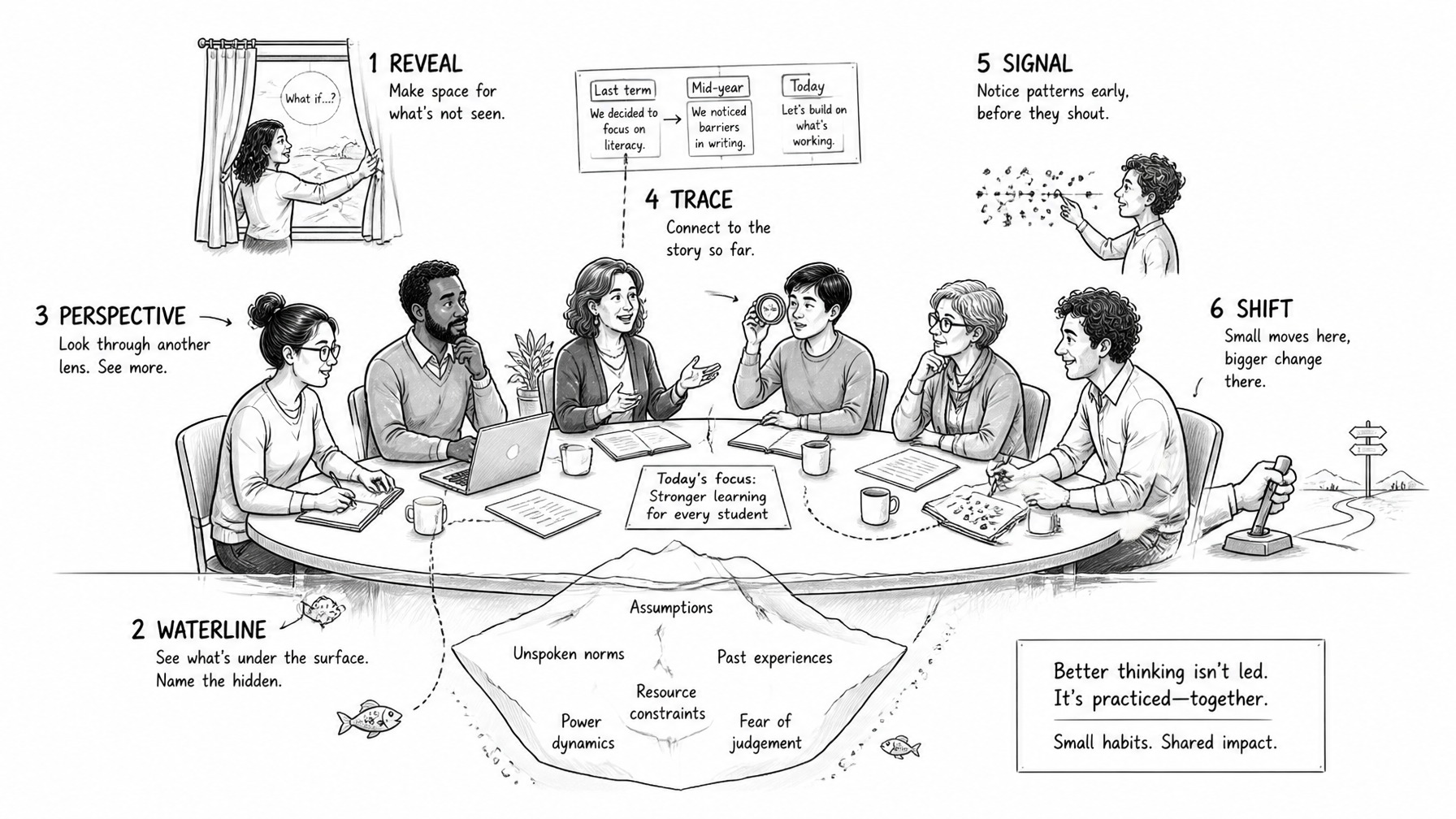
Reveal - what haven't we heard yet? Groups often mistake the conversation that happened for the conversation that was possible. Reveal creates deliberate space for hidden perspectives, quieter voices and missing information.
Waterline - what's happening beneath the surface? Visible behaviours usually have invisible causes. Waterline helps groups examine the assumptions, incentives and conditions producing what they see.
Perspective - whose view are we missing? Every group sees from somewhere. Perspective helps teams recognise the viewpoints, experiences and constraints that are absent from the current discussion.
Seeing creates awareness. But awareness alone isn't enough. Groups also need to understand how patterns form.
Trace - how did we get here? Every decision has a history. Trace protects organisational memory by reconnecting current actions with previous assumptions and choices.
Signal - what signals are people reading? People adapt to the environment they experience, not only the messages they receive. Signal examines what the organisation is unintentionally teaching people to expect.
Understanding creates insight. But insight only matters when it changes what happens next.
Shift - what small change would create movement? Complex systems rarely change through one large intervention. Shift focuses attention on small, deliberate adjustments that can create new patterns over time.
The smallest routines are not small
Culture is often discussed through values, vision and strategy. These matter, but they are not where culture is finally formed. Culture is rehearsed in ordinary moments.
How a meeting starts. Whose voice is heard. What questions are asked. What information is noticed. How decisions are remembered. Whether assumptions can be challenged.
Repeated moments become repeated expectations. Repeated expectations become shared habits. Shared habits become culture. Culture remembers what we practise.
So the question for any team is not only "what kind of culture do we want?" It is also "what are we repeatedly doing that teaches this culture to exist?" Because if we want different school cultures, we need to design the habits that create them.
Which returns us to the first question: how do we build groups that share responsibility for thinking, not just for tasks?
The six habits described here - Reveal, Waterline, Perspective, Trace, Signal and Shift - are practised experientially in Designing the Waterline, a Synnovate workshop that helps teams design the routines that make better collective thinking normal. It is the third workshop in an arc that begins with Beneath the Waterline and Waterline Lab.